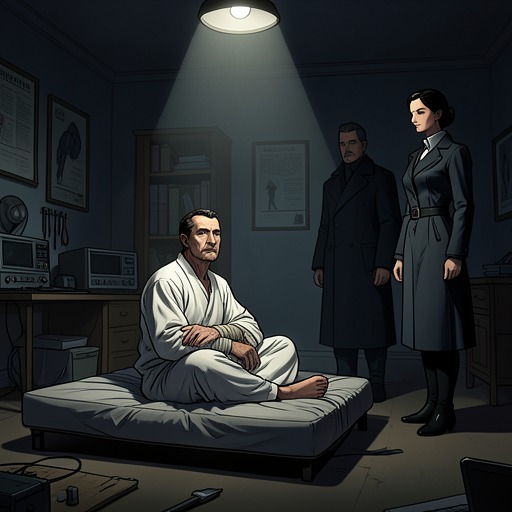
Benton Wesley
Kay ScarpettaBenton Wesley functions as the novel’s principal psychological interpreter and one of its most emotionally exposed investigators. A forensic psychologist associated with McLean Hospital, Harvard, the John Jay College of Criminal Justice, and formerly the FBI’s behavioral-science division at Quantico, he brings clinical authority to a case shaped by paranoia, impersonation, sexual violence, murder, and media distortion. Yet his knowledge does not make him invulnerable: his devotion to Kay Scarpetta turns the crimes against her into a personal breach, forcing him to confront jealousy, guilt, and the limits of professional detachment.
Identity and Professional Position
Benton is introduced working from a modern forensic-psychiatric unit at Bellevue Hospital, where a headphone connection links him to Scarpetta across 240 kilometers. He tells her that a man has been admitted to the psychiatric service and that Jaime Berger wants Scarpetta to examine the man’s injuries. The arrangement places Benton between clinical evaluation and criminal investigation: he is not merely treating a patient, nor merely supplying a police profile, but helping determine how bodily evidence and mental disturbance should be read together.
His professional setting is repeatedly associated with observation and distance. He sits against a view of ugly red brick in gray winter light, speaking by telephone while assessing the case, and later appears on television identified as a forensic psychologist at McLean Hospital. The public appearance confirms his institutional standing and gives his expertise a second function: he can translate specialized knowledge into an appeal addressed directly to a fugitive. His authority therefore operates both inside controlled clinical spaces and before a mass audience.
Assessment of Oscar Bane
Benton’s evaluation of Oscar Bane is defined by contradiction rather than by a simple diagnosis. The MMPI-2 indicates a tendency toward social introversion. In the Rorschach test, Oscar sees buildings, flowers, lakes, and mountains but no people; the same pattern appears in the TAT. His drawings include a forest with eyes and faces in the leaves, as well as mature but nonhuman figures consisting only of faces with hollow eyes. Benton reads these images as signs of isolation, frustration, fear, nervousness, and persecutory delusion.
The decisive qualification is temporal. Benton finds evidence that Oscar is paranoid, feels watched, and experiences his fear as real, but nothing indicates long-standing paranoia. He emphasizes that the condition appears recent. This distinction prevents the evaluation from becoming a blanket dismissal of Oscar’s testimony: the patient may be interpreting events in a distorted way, but his immediate terror is psychologically genuine. Benton’s clinical judgment thus preserves an unstable middle ground between illness and victimization.
Oscar’s fear also appears physically during the examination. When Scarpetta picks up forceps, he stares at them anxiously and says that she does not need them because he can remove the dressing himself. Benton’s earlier assessment helps explain why an ordinary medical instrument becomes threatening to Oscar, but it does not reduce the moment to mere theatricality. The patient’s body reacts before his account can be tested, making fear a form of evidence even when the story attached to it remains uncertain.
Intimacy, Jealousy, and Guilt
Benton’s relation to Scarpetta is both marital and professionally entwined. He recalls meeting her in 1990, when she appeared in a conference-room doorway with untidy blond hair, an unmade face, and a long white laboratory coat bulging with pens, tissues, and pink reminder slips. He immediately recognized that the woman’s serious, forceful exterior concealed kindness and care. Years later, he continues to notice her straight nose, strong jaw, prominent cheekbones, and the deliberate grace of even the smallest gesture, such as turning a page.
That admiration is inseparable from fear of loss. After the assault on Scarpetta, Benton admits that he is furious at her, then recoils from the unfairness of that anger because she is the person who suffered the injury. He understands why she allowed Pete Marino into her home: Marino had worked with her for years, and friendship could explain letting him in while drunk and disoriented. Benton also acknowledges that Marino’s desire for Scarpetta had existed for a long time, even though she had tried not to encourage it or wound him unnecessarily.
The admission reveals Benton’s central emotional conflict. He can analyze the circumstances and recognize that Scarpetta is not responsible, yet analysis does not dissolve his resentment. He experiences Marino as an enemy who has entered the house, while the narrative makes clear that the “enemy” is not an external criminal alone but a threat carried through intimacy, trust, and old professional bonds. Benton’s protectiveness is therefore morally compromised by possessiveness, and his guilt arises from recognizing that his anger has shifted toward the victim rather than toward the person who harmed her.
Reading Evidence and Deception
Benton participates in the reconstruction of assaults by treating physical details as a sequence of actions. In the investigation of Eva Peebles’s death, Scarpetta argues that the killer had already tied the victim’s wrists behind her back before cutting open her robe and bra. Benton follows the implication: the attacker must have overpowered her with extraordinary speed, probably through a surprise attack immediately after she opened the door or as he entered. The clothing becomes a record of chronology, distinguishing restraint, undressing, and possible sexual intent.
The same evidentiary discipline governs the question of whether intercourse occurred. Scarpetta reports that swabs tested negative for sperm and that DNA testing provides no indication of sexual contact, while insisting that the absence of intercourse does not eliminate the possibility that sexual violence was intended. Benton’s role in this investigative world is not to force ambiguous evidence into a convenient conclusion but to work within the tension between intention and completed act, testimony and material trace.
He is also alert to the way false statements borrow the language of authority. Oscar repeats the claim that a perfect crime does not exist and attributes to Scarpetta a saying about criminals always making a foolish mistake. Scarpetta cannot remember ever quoting Oscar Wilde in that form or claiming that she herself could commit a perfect crime. Benton’s psychological work consequently intersects with textual and digital impersonation: the words are evidence not only of Oscar’s disturbed beliefs but of someone’s manipulation of identities and remembered speech.
When the Gotham Gotcha website malfunctions, Benton and Scarpetta encounter a visual field of darkened buildings, red lightning, and the Rockefeller Center Christmas tree turned upside down in Central Park. His immediate reaction that the display is strange marks the collapse of a supposedly stable public platform. The site’s failure and its hostile columns show that media can function as a crime scene, preserving distortions while also becoming vulnerable to sabotage.
Public Intervention and Narrative Significance
Benton’s most overtly public action comes through a televised appeal to Oscar. Walking through Central Park South, Marino watches Benton on Headline News, where the screen identifies him as a forensic psychologist at McLean Hospital and as a former head of the FBI’s behavioral-science division. Benton states that he has come because the matter is urgent and asks Oscar to contact the FBI. The appeal transforms clinical authority into a protective instrument, offering communication rather than only pursuit.
His judgment also helps correct the investigation’s early knowledge gaps. Lucy Farinelli discovers that the scarpetta612 account drafted an email at 8:19 p.m. but did not send it, a fact that makes it impossible for either Terri Bridges or Oscar Bane to have written it. Benton’s broader interpretation of Terri is similarly corrective: he regards her as conscientious and believes she deleted more than a hundred emails because fear drove her to erase evidence connecting her to Gotham Gotcha and to the fabricated correspondence with Scarpetta.
By the end, Benton understands Terri Bridges through the chain of humiliation, idealization, and retaliation that shaped her actions. He believes she did not delete the emails because she foresaw her death, but because she had anonymously committed a crime against the medical examiner she would eventually encounter in the morgue. He also understands why Terri came to hate Scarpetta after receiving what she believed were cruel, demeaning messages from her heroine. Benton’s significance lies in this double vision: he can condemn deception while still tracing the wounded emotional logic that produced it. His professionalism does not eliminate feeling; it gives feeling a language precise enough to expose both violence and responsibility.